Remembering 1919: A Self-Guided Route Through Chicago History
By Allison Yates
Chicago is consistently ranked one of the most segregated cities in the United States—and many historians point to one event as the origin story of this egregious and ongoing disinvestment of communities of color: the Chicago Race Riots of 1919.
In 1919, a Black teenager named Eugene Williams was swimming with his friends at Chicago’s lakefront near 31st Street. As they were swimming, they began to drift off to the “white side” of the beach, unbeknownst to them. Shortly after, a white man named George Stauber threw stones at Eugene and his friends, and one of them hit Eugene, causing him to knock off the boat and drown. George Stuaber was never arrested. Over the following week, Black communities on Chicago’s South Side faced violent attacks and ultimately, over 500 people were injured and 38 people died (twenty-three Black and fifteen white) in what would later be named the Chicago Race Riots of 1919.
The white Chicagoans in power took these events and used them as a catalyst to double down on racist policies and further segregate a growing African American population, one that would reach nearly one million by then end of the Great Migration.
The events in Chicago were far from isolated. Across the United States, African Americans were targets of racial violence in what would later be coined the “Red Summer.”
Since 2023, Read & Run Chicago has partnered with Chicago Race Riot of 1919 Commemoration Project (CRR19), a commemoration project that proposes to use artistic markers to educate people about Chicago’s worst incident of racial violence, to host a running tour version of their annual commemoration bike tour.
After three years, we’re pausing our annual running tour and inviting readers & runners from Chicago and beyond to join CRR19’s 8th Annual Bike Tour on Saturday, July 25.
If you’re unable to attend the bike tour, here’s a one self-guided route you explore at your own pace and mode—whether running, walking, biking, scootering, skateboarding or rolling.
Along this route, you’ll be introduced to Black history in Bronzeville, spot several of the CRR19-sponsored historical markers, and pay your respects at the Eugene Williams Historical Marker, just a quarter mile north of 31st Street Beach.
Recommended Pre-Reading: A Few Red Drops: The Chicago Race Riot of 1919 by Claire Hartfield
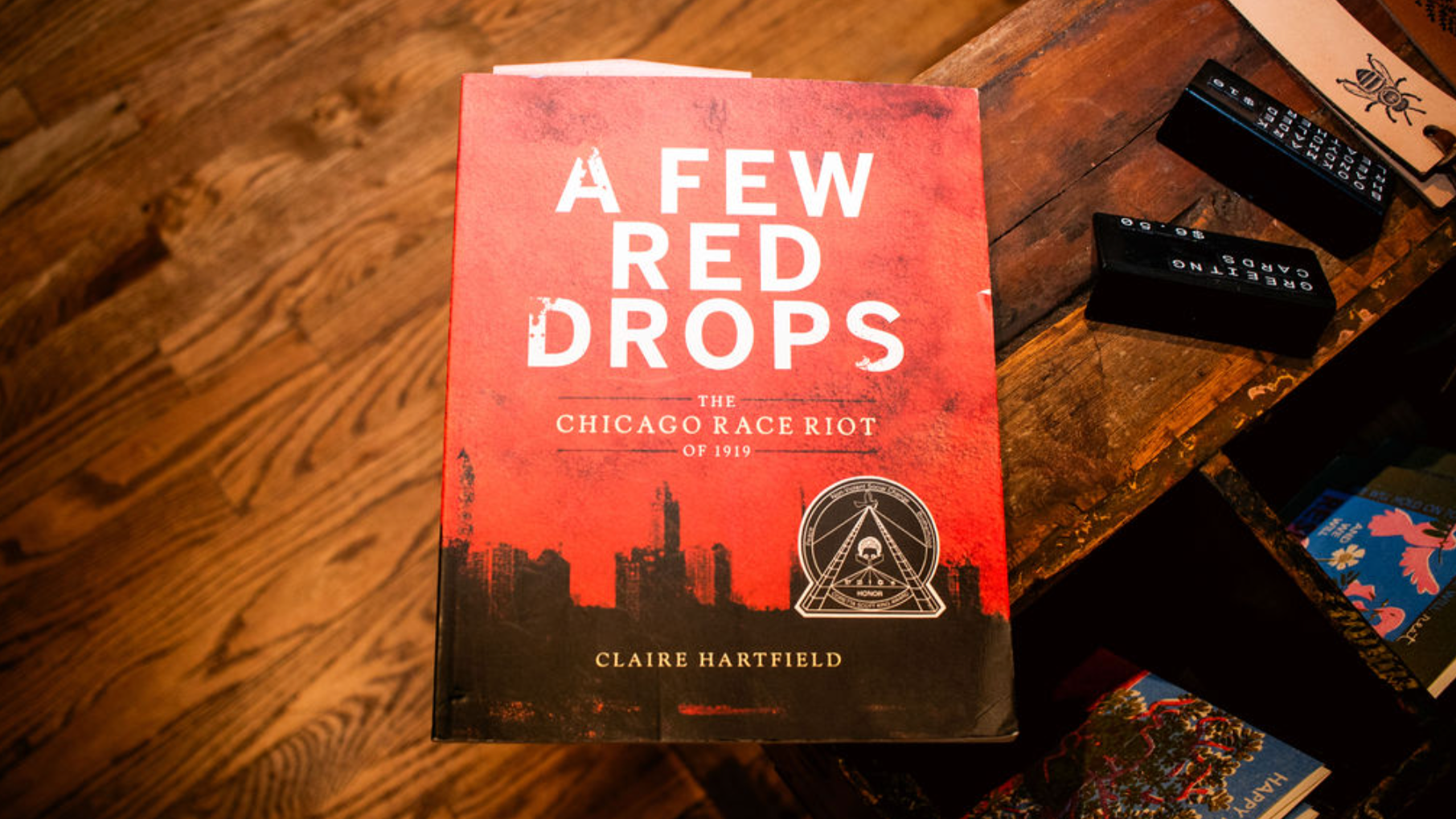
What it’s about: This meticulously researched nonfiction book delves into the causes and consequences of one of the most violent racial conflicts in American history, the 1919 Chicago Race Riots.
Why we picked it: While there are many books, poems, and other texts exploring the horrific events of what is referred to as the 1919 Chicago Race Riots, Claire Hartfield’s book contextualizes the historical period in a very approachable and accessible way. Appropriate for students aged middle schoolers and up, the nonfiction book provides incredible education on the entire history of the city. Hartfield shows that 1919 was not an isolated or random incident by examining how racial tensions, racist policies, and structural issues allowed this violence to happen. The author’s grandmother lived through these riots as a child in Bronzeville, so this history is personal to her.
The Running Tour
The Stops
Map at 35th & King Drive
Along 35th Street at the median of “Grand Boulevard” or “South Park Way,” you’ll find a relief map of historic Bronzeville. This area is one of the most historic parts of Bronzeville, a South Side Chicago neighborhood that was the port of entry for migrating African Americans and a hub for business, culture, and life. Take some time to examine the map—spot the locations of former businesses, homes of famous African Americans, and more.
The Chicago Defender Building
This building is the headquarters of the Chicago Defender, one of the widely known African American newspapers in the United States. Founded by Robert Abbott in 1905, the Defender is most known for its role in the Great Migration. Pullman porters discretely circulated the newspaper on train line routes between the North and the South, giving Southerners access to job advertisements, news, and hope for a better life in the North. In the context of the 1919 Chicago Race Riots, most of the information we know today is thanks to the diligent reporting of the Defender—when mainstream media did not honor Black victims and manipulated the truth, this newspaper was committed to accurate reporting.
Vortex of Violence
Pay your respects to some of the Chicagoans who lost their lives as you admire the historical markers at 35th Street and State Street, just under the CTA Green Line tracks.
Chicago Bee Branch, Chicago Public Library
This branch of the Chicago Public Library was the former home of the Chicago Bee, a leading African-American newspaper and contemporary of The Chicago Defender founded by cosmetics entrepreneur Anthony Overton. Much like the Defender, the Bee was committed to giving Black Chicagoans a voice when the mainstream media perpetuated false narratives.
Ida B. Wells Light of Truth Monument
This bronze and marble statue on the site of the former Ida B. Wells homes by renowned sculptor Richard Hunt honors the journalist and anti-lynching activist Ida B. Wells, who lived nearby at 3624 S Martin Luther King Jr. Dr. The monument gets its name from the famous Wells quote: “The way to right wrongs is to turn the light of truth upon them.” During the 1919 Race Riots, Wells bravely documented the events and called for justice for those victimized.